Shoulder Health for the Desk-Bound: Reclaiming Your Range of Motion
Your laptop is making your shoulders "sticky." Learn why the overhead press and active hangs are the ultimate antidote to the "Desktop Hunch."
If you spend eight hours a day hunched over a laptop, a steering wheel, or a smartphone, your shoulders are paying a heavy biological price. In the coaching world, we call this the "Desktop Hunch." It is a posture characterised by shoulders that roll forward into internal rotation, a chest that becomes chronically tight, and an upper back that loses its ability to move, effectively becoming a rigid, unmoving block.
Your body is a masterpiece of efficiency. It is constantly trying to adapt to the demands you place upon it. If you spend the majority of your waking hours in a rounded, seated position, your body will eventually "scaffold" that area with tight connective tissue. The problem arises when you step away from the desk and try to be a functional human being. When you try to lift a heavy bag into an overhead compartment, play tennis, or reach for the top shelf, your joints are "stuck." This is where "scratchy" shoulders, impingements, and chronic neck pain originate. At our box, we use Movement as Medicine to reclaim your range of motion and "un-stick" your life.
Shoulder mobility desk workers posture pain: The Power of the "Active Hang"
One of the simplest and most effective tools we have in the box is the pull-up bar itself. I am a huge advocate for the Active Hang. By hanging from the bar for just 30 to 60 seconds, you are using your own body weight to provide a "de-compressing" stretch to the shoulder girdle and the spine.
This isn't a "passive" stretch where you just dangle like a wet noodle. It is an active movement where you keep your midline braced and your shoulders "tucked" into their sockets. This improves your grip strength—a key marker of longevity—while simultaneously "un-sticking" the tissues of the lat and the chest. It is a biological reset for anyone who spends their day in a sedentary role.
The Art of the Hang: Pronated vs. Supinated
To get the most out of your time on the bar, we need to look at the orientation of your hands. At CrossFit Chiltern, I want you to alternate between two specific hanging grips:
The Pronated Hang (Overhand): This is your traditional pull-up grip with palms facing away. This grip is fantastic for building the structural integrity of the upper back and the lats. It teaches you how to keep the shoulder blade stable and "packed" while under tension.
The Supinated Hang (Underhand): This is the chin-up grip with palms facing toward you. I use it specifically because it has a significantly bigger stretch effect. The supinated hang puts the biceps and the anterior fascia of the shoulder under a much deeper stretch. For someone who has been hunched over a laptop all day, this underhand grip reopens the front of the body, stretching out the tight pectorals and connective tissues that have been "shortened" by hours of typing.
The Overhead Antidote: Breaking the Scaffold
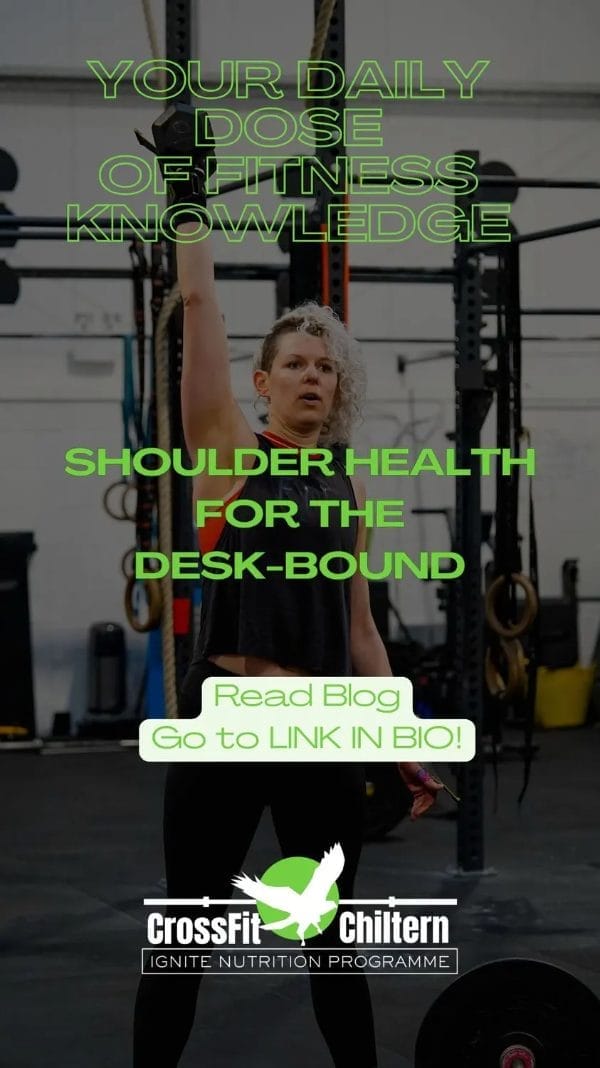
Beyond the bar, we use the Overhead Press to reclaim functional strength. The human shoulder is designed for a massive range of motion, but if you never reach fully overhead with load, your body "down-regulates" the mobility of the joint.
By performing strict presses, we force the shoulders back into their natural, healthy alignment. By strengthening the "retractors" of your upper back and opening the "flexors" of your chest, we aren't just getting you fit; we are fixing your structural integrity. I often tell my athletes that the "exciting" stuff—the snatches and the handstands—is only possible once we have addressed the "boring" stuff: the foundational range of motion that has been stolen by your workstation.
Ignite Corner: Dr. Amy George on Posture and Stress
Your postural health is directly linked to your internal state and your nervous system. Dr. Amy George, our Nutrition and Lifestyle coach heading up our Ignite Programme, often points out that a "flexed" posture—shoulders rolled forward, head down—is the physical manifestation of a stressed nervous system.
When your chest is tight and your shoulders are rolled, your breathing becomes shallow and "apical" (using only the top of the lungs). This signals to your brain that you are in a "fight or flight" state, which keeps your cortisol levels permanently elevated. By opening your chest and reclaiming your shoulders through our hanging and pressing protocols, you aren't just improving your gym performance; you are physically allowing your body to down-regulate and manage stress more effectively.
As Amy says, "Structure dictates function." We want you to leave the box feeling taller, lighter, and more relaxed than when you walked in.
Consistency Over Aggression
You cannot fix ten years of desk work in a single 60-minute session. It requires consistency, patience, and professional guidance. At CrossFit Chiltern, our coaches will scale your overhead work to ensure you are moving safely while you slowly reclaim your range. We prioritise mechanics first, ensuring your spine is stable before we ever talk about adding intensity to the joint.
I want you to look at your 5-year journey. Do you want to be the person who is progressively getting more "locked up" and restricted as the years go by? Or do you want to be the person who maintains the fluidity and power of an athlete? Don't let your laptop steal your vitality. Take the lead, trust the process, and let's get those shoulders moving again.
Tired of "sticky" shoulders and chronic neck pain? Book a Discovery Call today with one of our team and let's get you moving again!
Ready to put this into practice? Join a class at CrossFit Chiltern in Amersham — our coaches will guide you every step of the way.