The Truth About Core Work: Building an Unbreakable Chassis
It's the movement you love to hate. Discover why Bulgarian Split Squats are the secret to fixing your "weak side" and protecting your joints for the long term.
If you scroll through any fitness social media feed today, you’ll be bombarded with "core" workouts that involve endless variations of sit-ups, crunches, and bicycle kicks. The marketing usually promises a "shredded midsection" or "six-pack abs for summer." But as your Head Coach at CrossFit Chiltern, I want to pull back the curtain on a hard truth: Most of what the world calls "core work" is almost entirely useless for real-world performance and long-term health.
In our box, we don't view the core as a series of muscles designed to make you look good in the mirror. We view it as your chassis. In any high-performance vehicle, the engine is only as effective as the chassis’s ability to handle the power. If your chassis is "squishy" or unstable, you leak energy, you lose power, and eventually, the system breaks. True core work isn't about creating motion; it is about the discipline of resisting motion. Today, I want to break down the three keys to a functional core and explain the difference between our "main movements" and the "accessories" we use to support them.
Key 1: Anti-Flexion and Anti-Extension (The Heavy Carry vs. The Plank)
The most fundamental job of your core is to protect your spine by resisting the forces that want to fold you in half or over-arch your back. This is known as Anti-Flexion and Anti-Extension.
Most people think of the Plank as the gold standard here. While the plank is a fantastic accessory—a "test" of your ability to hold a neutral spine—it is essentially the "entry-level" version of this skill.
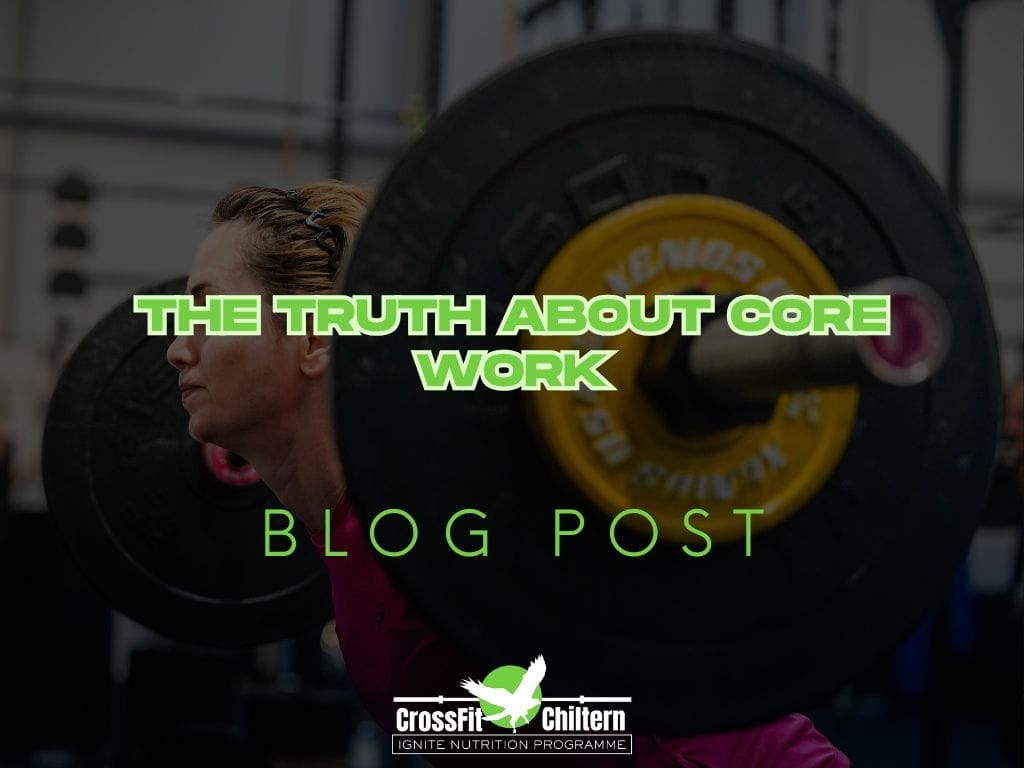
The real work happens under the barbell. When you perform a Back Squat, a Front Squat, or a Clean, you are performing a high-stakes, high-voltage version of a plank. As you move that weight, gravity is trying to fold your chest toward your knees. Your core—the entire system from your shoulders to your hips—has to work at maximum capacity to stay rigid. If you can't stay tight through a heavy clean, you aren't just "failing the lift"; you are showing a leak in your chassis. We use planks to build the baseline, but we use the barbell to build the unbreakable spine needed to lift a heavy suitcase into an overhead compartment.
Key 2: Anti-Rotation (The Shoulder Sandbag vs. The Pallof Press)
The second key is Anti-Rotation—the ability to keep your torso square and stable when a force is trying to twist you.
In class, we often use the Pallof Press (resisting a band trying to pull you sideways) as an accessory. It is a brilliant way to isolate the "oblique" system and teach your brain how to "switch on" the muscles that stop rotation. However, it remains a controlled, stationary exercise.
The "Main Event" for anti-rotation is the Shoulder Sandbag Squat. When you heave a heavy sandbag onto one shoulder, the load is offset. That bag is trying to twist your torso and pull you out of alignment with every centimetre you descend. By squatting or lunging with that offset weight, you are training your system to fight rotation in a dynamic, high-pressure environment. This is the strength that protects you when a toddler suddenly squirming in your arms tries to twist your back. The Pallof Press teaches the skill; the sandbag builds the capacity.
Key 3: Anti-Lateral Flexion (The Suitcase Deadlift vs. The Side Plank)
The final piece of the puzzle is Anti-Lateral Flexion—resisting the urge to "bend sideways" under load. This is perhaps the most neglected area of core training in traditional gyms, yet it is vital for balance.
We use the Side Plank as our primary accessory here. It’s an excellent way to check for imbalances between your left and right side. But just like the standard plank, it is a static starting point.
To build real-world resilience, we move to the Suitcase Deadlift and Single-Arm Overhead Carries. When you deadlift a heavy weight with only one hand, or walk with a kettlebell locked out overhead, your internal "corset" has to fire with incredible intensity to keep your spine vertical. If you "collapse" to the side, you are exposing your vertebrae to unnecessary risk. This is the functional strength that allows you to carry a heavy bag of shopping across a car park without your posture crumbling.
The Professional Identity of the Rigid Chassis
I want you to stop thinking of "core work" as something you do for ten minutes at the end of a class. I want you to see every movement—every squat, every carry, every clean—as an opportunity to build a more resilient chassis.
The planks, side planks, and Pallof presses are the "maintenance" in your programme. They ensure the "software" is running correctly. But the "hardware"—the actual density and strength of your spine—is built when you pick up a heavy, awkward object and refuse to let it move you.
Take full responsibility for your own training. Stop chasing the "burn" of a thousand sit-ups and start chasing the "stiffness" of a perfectly braced carry. Your chassis—and your future self—will thank you for it.
CTA: Ready to build a core that actually works for the real world? Book a Discovery Call today with one of our team and let’s look at your "Chassis" together! [Link: https://www.google.com/search?q=https://kilo.gymleadmachine.com/widget/booking/sdUjnJkKy9dGRSLzEGzz]